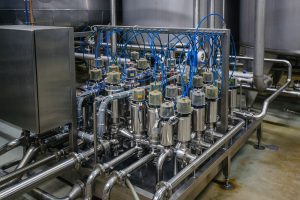

Compressed air can become a food safety risk whenever it touches exposed food, ingredients, packaging interiors, or food-contact equipment. FDA regulations require compressed air used in or around food-contact applications to be treated so it does not contaminate food, but FDA does not establish one universal testing schedule or purity limit for every facility. SQF Edition 10 is more specific: compressed air that contacts food or food-contact surfaces must be maintained and monitored for applicable hazards, with testing performed at least annually and more frequently when justified by risk. A defensible program identifies every product-contact point, evaluates particles, moisture, oil, and microorganisms, establishes site-specific limits, tests at representative points of use, documents corrective actions, and repeats testing after significant system changes or failures.
Compressed air is often treated as a utility, but in a food or beverage plant it can also function like an ingredient or processing input.
It may be used to:
The food safety risk depends on how the air is used. Air that remains inside a sealed actuator is not the same risk as air blown directly onto a ready-to-eat product.
When compressed air contacts exposed food or a food-contact surface, contaminants in the system may be transferred to the product. Potential contaminants include rust, pipe scale, atmospheric dirt, condensed water, oil aerosols, oil vapor, and microorganisms. SQFI specifically identifies particles, water, and oil as potential contamination sources and notes that compressed air can present both chemical and microbiological risks.
FDA’s requirement is based on preventing contamination rather than meeting one universal compressed air specification.
Under 21 CFR 117.40(g), compressed air or other gases mechanically introduced into food, or used to clean food-contact surfaces or equipment, must be treated so food is not contaminated with unlawful indirect food additives. FDA also requires pneumatic and automated food systems to be designed so they can be maintained in a clean and sanitary condition.
In practical terms, FDA expects a facility to determine:
FDA does not publish one required compressed air test panel, one purity class, or one mandatory annual testing schedule that applies to every food plant. The appropriate program depends on the product, process, air application, equipment, and risk.
That distinction is important. A bakery using compressed air inside closed machine actuators may need a different program than a dairy, beverage filler, meat processor, or ready-to-eat food facility using air directly over exposed product.
Facilities covered by the Preventive Controls for Human Food rule must maintain a written food safety plan that includes a hazard analysis and appropriate risk-based controls. FDA explains that each covered facility generally needs its own plan because equipment, layouts, products, and processes differ from one site to another.
SQF Edition 10 provides a clearer minimum expectation.
For food manufacturing sites, compressed air systems and systems used to store or dispense other gases that contact food or food-contact surfaces must be maintained and regularly monitored for quality and applicable food safety hazards. The frequency of analysis must be risk-based and performed at least annually.
Annual testing is therefore the minimum for applicable direct-contact and food-contact applications. It is not necessarily the correct frequency for every facility or every sampling point.
More frequent testing may be justified when:
SQF guidance also recommends high-efficiency point-of-use filtration where compressed air contacts food directly or indirectly. It states that the final filter should be located near the point where air enters the last section of tubing rather than relying only on filtration in the compressor room. Its general recommendation is a final-stage rating of 0.01 micron at 99.999% efficiency, unless the site’s risk analysis supports another specification.
The SQF Code itself is the auditable requirement. SQFI guidance documents help facilities interpret and implement the Code, but the Code takes precedence if the two differ.
A food and beverage compressed air testing plan commonly evaluates four major contaminant categories.
Particle testing looks for contaminants such as:
Particles can originate in the ambient intake air, compressor, dryer, filters, receiver, or distribution piping.
A passing result at the compressor room does not guarantee clean air at the production line. Rust and scale may enter the airstream downstream, which is why representative point-of-use testing is important.
Moisture may be present as:
Moisture encourages corrosion and may create conditions that support microbial contamination. It can also damage valves, ruin dry ingredients, cause packaging defects, and shorten filter life.
A pressure dew point measurement helps determine how effectively the dryer removes moisture. The correct limit depends on the process and environmental conditions. A plant with piping exposed to freezing temperatures will usually need a lower pressure dew point than a fully conditioned indoor facility.
Oil testing may assess:
Possible sources include lubricated compressors, ambient intake air, nearby vehicle exhaust, manufacturing emissions, and maintenance products used around the system.
Installing an oil-free compressor does not automatically guarantee oil-free air at the point of use. The intake air, downstream piping, storage receivers, and previous system contamination can still affect results.
SQFI guidance states that when compressed air contacts exposed food or direct food-contact surfaces, compressor oil should be food grade. It also recommends upstream filtration to protect the final-stage filter from oil and water aerosols.
Microbiological testing may evaluate:
Compressed air does not create microorganisms, but contamination can enter through the compressor intake or develop in wet, poorly maintained portions of the system.
There is no single universal microbial limit that fits every food product and process. The facility must establish a defensible specification based on product risk, air use, historical data, customer requirements, and its food safety plan.
ISO 8573-1 is commonly used to describe compressed air purity classes for particles, water, and oil. The standard applies regardless of where in the compressed air system the air is specified or measured. It also recognizes gaseous and microbiological contaminants, although the primary purity-class structure focuses on particles, water, and oil.
ISO 8573 is useful because it gives the facility and testing provider a shared technical language. Instead of saying that air must be “clean” or “food grade,” a specification can identify measurable limits for each relevant contaminant.
However, ISO 8573 does not automatically tell every food facility which class it must achieve. The site still needs to choose appropriate limits based on its hazard analysis.
A stronger specification states:
The goal is not to select the strictest possible class without considering the process. The goal is to select a scientifically defensible specification that protects the product.
One of the most important preparation steps is classifying every compressed air use.
Compressed air is direct contact when it touches exposed food, ingredients, beverages, or the inside of primary packaging.
Examples include:
These points usually require the most stringent controls and testing.
Compressed air may not touch the product itself but can contact a surface that later touches food.
Examples include:
These applications still fall within FDA and SQF expectations when contamination could transfer to food.
Some compressed air applications remain isolated from food and food-contact surfaces.
Examples include:
Non-contact air may present a lower food safety risk, but the classification should be documented rather than assumed.
Sampling only at the compressor outlet provides an incomplete view of the system.
A risk-based sampling plan should consider:
The most valuable sample is usually taken where the air actually interacts with the food process.
A plant with dozens of drops may not need to test every outlet every year, but it should have a documented rationale for selecting representative locations. Rotating lower-risk sampling points while consistently monitoring critical direct-contact points can provide broader system coverage over time.
For SQF-certified food manufacturing sites, applicable compressed air must be tested at least annually, and the actual frequency must be based on risk.
Testing should also be considered after:
A strong program uses annual verification as a baseline, then adds event-driven testing where changes could affect air quality.
Create or update a diagram showing:
The diagram should identify the direction of flow and the relationship between treatment equipment and sampling points.
For each use, document:
This risk assessment should drive sampling locations, specifications, and frequency.
Avoid relying on phrases such as “clean air,” “instrument air,” or “food-grade air” without measurable definitions.
Document acceptable limits for:
The limits should be connected to the site’s hazard analysis, customer requirements, process needs, and chosen standards.
Before testing, confirm when the facility last:
Testing is more meaningful when the results can be compared with system condition and maintenance history.
Look for:
SQFI guidance emphasizes final filtration at the point of use because contaminants may enter the air after it leaves the compressor room.
Testing should reflect normal production conditions whenever possible.
Document:
A test conducted during an unusual shutdown may not represent the risks present during normal operation.
Do not wait for a failed result to decide what happens next.
The written plan should identify:
An FDA investigator or SQF auditor may want evidence that the compressed air program is based on risk and consistently implemented.
Be prepared to provide:
SQF auditors review documented procedures and records, interview employees, and observe whether the food safety system is implemented in practice. SQFI describes this expectation as doing what the site’s documented system says it does.
Assuming an oil-free compressor eliminates the need to test
Oil-free compression reduces one potential source, but it does not eliminate particles, moisture, microorganisms, intake contamination, or residue already in the distribution system.
Testing only in the compressor room
This may miss contamination introduced by receivers, piping, hoses, fittings, or local equipment.
Using limits without documenting why they apply
Copying an ISO class from another facility does not demonstrate that the specification is appropriate for your products and processes.
Treating annual testing as the entire program
Annual testing is verification. It does not replace routine dryer monitoring, filter maintenance, drain inspection, or corrective action.
Ignoring microbiological risk
Particles, oil, and dew point are important, but direct-contact air may also require microbiological evaluation based on product and process risk.
Failing to retest after corrective action
Replacing a filter or repairing a dryer does not prove the problem has been corrected. Follow-up testing closes the loop.
A strong food and beverage compressed air program connects four elements:
Compressed air quality should not be treated as a once-a-year laboratory task. Testing works best as part of a broader system that includes equipment maintenance, dew point monitoring, point-of-use filtration, documented inspections, and trend review.
The best time to find a compressed air problem is before an FDA inspection, SQF audit, customer visit, or product complaint.
Begin by mapping where compressed air contacts your process. Define what acceptable air quality means for each application. Test at the point of use, not just at the compressor. Review the results alongside maintenance records, and document what happens when the system falls outside its limits.
Compressor Maintenance Co. can help food and beverage facilities evaluate compressed air treatment, identify representative sampling points, review dryer and filtration performance, and correct system conditions that may contribute to failed testing.

We’re looking forward to working with you. Whether you have questions about products or services, our team is ready to help.
FDA requires compressed air introduced into food or used to clean food-contact surfaces and equipment to be treated so it does not contaminate food. FDA does not establish one universal testing frequency or purity limit for every food facility, so sites must use their hazard analysis and preventive-control system to determine appropriate verification.
SQF Edition 10 requires compressed air that contacts food or food-contact surfaces to be analyzed at least annually. The testing frequency must also be risk-based, which means higher-risk applications may need more frequent testing.
Testing commonly evaluates solid particles, water or pressure dew point, oil, and microorganisms. The exact test panel should be based on the application, product risk, air-contact classification, and written food safety plan.
FDA and SQF do not assign one universal ISO 8573 class to every food facility. ISO 8573-1 provides a recognized system for defining particle, water, and oil purity classes, but the facility must select and justify specifications appropriate for its process.
Samples should be taken at representative points of use, especially where air directly contacts exposed food, primary packaging, or food-contact surfaces. Testing only at the compressor outlet may miss contamination introduced downstream.
Not universally. The correct compressor and treatment system depend on the process and risk assessment. SQFI guidance states that where compressed air contacts exposed food or direct food-contact surfaces, lubricants used by the compressor should be food grade. Appropriate filtration and verification are still necessary.
The facility should stop or control the affected use as appropriate, investigate the source, assess potentially affected product, correct the problem, document the response, and retest before returning the application to normal service.
Retesting should be considered after maintenance or system changes that could affect air quality, including compressor work, filter replacement, dryer repairs, piping modifications, or corrective action following a failed result.